Protect your muscle health and achieve lasting metabolic results with an interdisciplinary care approach.
By Christian Reyes, PT, DPT,CSCS
GLP-1’s (Glucagon-like peptide-1 receptor agonists and dual incretin therapies), such as semaglutide (Ozempic, Wegovy) and tirzepatide (Mounjaro, Zepbound), have revolutionized metabolic medicine. Today, About 1 in 5 American adults has now taken a GLP-1 medication (KFF, 2026). While these treatments deliver impressive scale weight reduction averaging 15% to 20% of total body weight, they also introduce a critical physiological challenge: a significant portion of the weight lost can come from lean muscle mass rather than fat tissue alone.
Your PT at POST PT will be your resistance training guide during your weight loss journey! Call 617-860-6430 or email info@postpt.com to get started today!
Without targeted resistance training and structured clinical guidance, losing muscle mass increases your vulnerability to sarcopenia—a clinical state marked by reduced muscle strength, lower physical performance, and impaired metabolic function.
Integrating a physical therapist (PT) into your GLP-1 treatment journey ensures that weight reduction prioritizes fat loss, protects functional independence, and builds a sustainable foundation for lifelong health.

The Hidden Risk: GLP-1 Medications and Sarcopenia
GLP-1 medications work by mimicking gut hormones that delay gastric emptying, suppress appetite, and diminish "food noise". This dramatic shift in caloric intake creates a significant energy deficit. However, when the body experiences sustained calorie restriction, it breaks down both adipose (fat) tissue and skeletal muscle for energy.
Studies reveal that fat-free mass (FFM) can account for anywhere from 15% to up to 60% of total weight lost during pharmacologically induced weight loss.
Why Muscle Loss Matters
Skeletal muscle is far more than a tool for movement, it is a central endocrine organ critical to your health:
Metabolic Powerhouse: Lean muscle is the primary site for glucose disposal and insulin regulation. Losing muscle can negatively alter resting metabolic rate and glucose stability.
Functional Capacity: Reductions in muscle volume and quality lead to decreased muscular endurance, reduced joint stability, higher risk of tendinopathies, and greater long-term fall risk.
Sarcopenic Obesity Risk: Sarcopenic obesity occurs when low muscle mass and impaired strength coexist with high adiposity. Rapid weight loss in individuals with low baseline muscle reserves significantly increases the risk of functional decline.
The Power of Interdisciplinary Care: A Three-Pillar Team Approach
Navigating GLP-1 therapy successfully requires more than just filling a prescription. Optimal muscle preservation relies on a collaborative, interdisciplinary care team working together toward your overall physical and metabolic health.
1. The Referring Provider (Primary Care Physician / Endocrinologist)
Your prescribing clinician manages drug initiation, monitors systemic biomarkers, and directs the medication titration schedule. If rapid weight loss occurs or physical performance declines, your provider can evaluate whether to temporarily hold or adjust the medication dosage while lifestyle interventions are optimized.
2. The Registered Dietitian (RD)
Severe appetite suppression often makes consuming adequate nutrition challenging. A registered dietitian establishes personalized protein targets—typically 1.2 to 1.6 grams per kilogram of body weight daily—evenly distributed across meals to trigger muscle protein synthesis. Dietitians also monitor for key micronutrient deficiencies (such as Vitamin D, calcium, and B vitamins) that directly influence muscle function.
3. The Physical Therapist (PT)
Physical therapists serve as movement and loading experts. Your PT conducts baseline functional strength and performance assessments, prescribes individualized resistance routines, monitors your tolerance for exercise, and guides the exercise intensity as your body composition evolves.
Optimal muscle preservation relies on a collaborative, interdisciplinary care team working together toward your overall physical and metabolic health.
5 Easy Resistance Training Exercises
To counteract anabolic resistance and maintain muscle quality during a caloric deficit, progressive resistance training is essential. Clinical guidelines recommend engaging in resistance exercise 2 to 3 times per week, targeting all major muscle groups.
Below are 5 accessible, highly effective exercises commonly integrated into a physical-therapy-guided program:
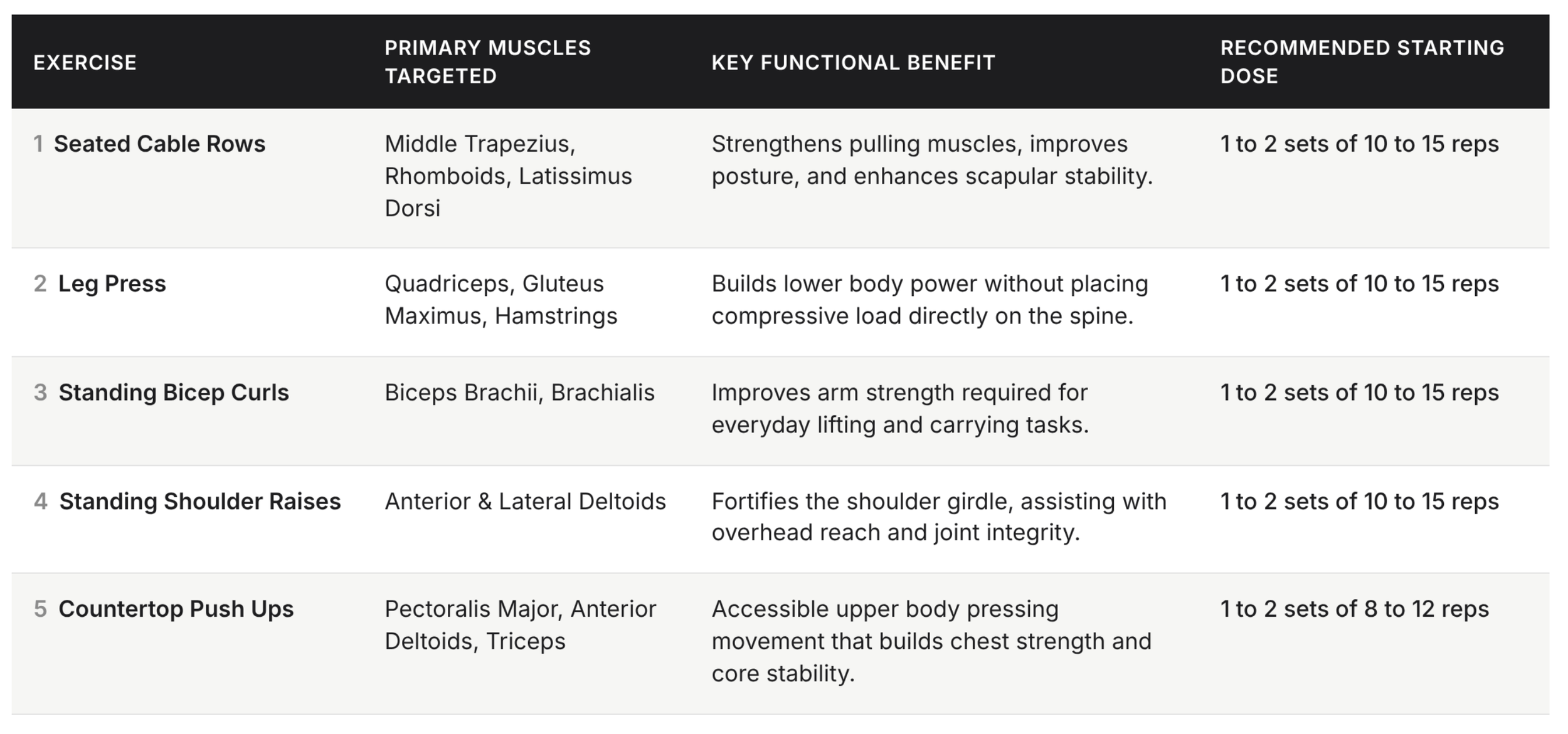
Exercise Execution Cues:

Seated Cable Rows: Sit upright with feet flat. Pull the handles toward your lower abdomen, squeezing your shoulder blades back and down. Avoid leaning backward momentum.
Leg Press: Position your feet hip-width apart on the sled platform. Lower the weight slowly until knees form a 90-degree angle, then press firmly through the full foot to return without locking your knees.
Standing Bicep Curls: Hold light dumbbells or resistance bands at your sides with palms forward. Keep your elbows pinned near your torso as you lift the weight toward shoulder level.
Standing Shoulder Raises (Lateral/Front): Stand tall with core engaged. Raise arms smoothly out to the sides or front up to shoulder height, avoiding shrugging your neck.
Countertop Push-Ups: Stand a few feet away from a sturdy kitchen counter. Place hands shoulder-width apart on the edge, lower your chest toward the counter keeping a straight body plank, then push firmly back to starting position.
What to Expect Working with a Physical Therapist
Baseline Assessment: During your initial evaluation, your PT will evaluate your baseline muscle strength, joint mobility, balance, and physical capacity.
Escalation Phase Management: During the first several months of dose increases (often 16 to 20 weeks), medication side effects like nausea or fatigue can temporarily lower energy levels. Your PT will focus on gentle mobility, stretching, and low-volume exercises to prepare soft tissues for heavier loads.
Maintenance Phase Progression: As your body adapts to a stable dose, your PT will progressively increase exercise resistance, sets, and repetitions to stimulate muscle growth.
Injury Prevention: Rapid body changes alter joint leverage and mechanics. Physical therapists continuously adjust exercise form to protect vulnerable tendons and weight-bearing joints.
Long-Term Health: Life Beyond Medication
Research indicates that nearly 34% to 50% of individuals discontinue GLP-1 medications within their first year. Upon discontinuation, appetite and "food noise" frequently return.
Establishing consistent exercise habits and muscle strength during medication use creates a permanent habit loop. By pairing GLP-1 pharmacotherapy with an active physical therapy routine and nutritionist guidance, you ensure that the weight you lose leads to a stronger, more resilient body for life.
Connect
Your PT at POST PT will be your resistance training guide during your weight loss journey! Visit www.postpt.com or call 617-860-6430 to get started today!
References
Belančić, Andrej, et al. "Preventive Strategies to Reduce Sarcopenia Risk During GLP-1-Based Anti-Obesity Therapy." Journal of Clinical Medicine, vol. 15, no. 15, 2026, p. 5870.
Hayhurst, Chris. "Weighty Matters: Physical Therapy and GLP-1 Medications." APTA Magazine, vol. 17, no. 7, Aug. 2025, pp. 16–23.
